From Seçil Erel

24.08.2015 - 20.09.2015 


It was raining heavily when we arrived to Geneva and to the house in Trelex. That was unusual for a  summer day... Then the rain stopped. We went out to the garden, smelled the grass and fresh air and  we saw the amazing house. It looked magical... That was very nice.  My friend Kerem Ozan Bayraktar, who is an artist and past resident, told me about Trelex Art  Residency, and I met Nina Rodin when she visited Contemporary Istanbul last year.


I hesitated about doing the residency because I have a little girl and she was almost 4 years at that  time. But Nina understood and motivated me, because she has 3 lovely children herself. The  residency was a very important experience for us. We left our normal lives and artistic practice, we  began living and working together. I recommend this experience to all artists.


Also, I am lucky because I knew the other resident artist Gizem Unlu. She is very lovely, calm, understanding young and talented artist. She helped us when we needed something. Switzerland has extremely beautiful nature. I loved Nyon. It is very close to Trelex and amazing little town near Leman Lac, across the Apls, at the foot of La Cura mountains. We swam in the clean but cold Leman Lac, or Geneva Lake, and enjoyed walking around. We visited museums, galleries, cafes and shops in Geneva; Lausanne, and Yvoire (in France).


I collected maps, because I am influenced by them in my work, but had never used them directly before. I painted maps with watercolor and pens.


In my work, I like to begin with a fictional infrastructure and let my pieces take shape through a production process directed by the natural, random flow of painting; hence questioning the precision and overlooked aspects of architecture and existence in the relationship between painting, life, space and time. 

I create new spaces and suggests new architectural systems by overlapping layers that eventually become spatializedy. 

My paintings seek to outgrow the boundaries of canvases, walls, ceilings and sometimes floors.  I decided to set up a studio installation in my area during my residency.  
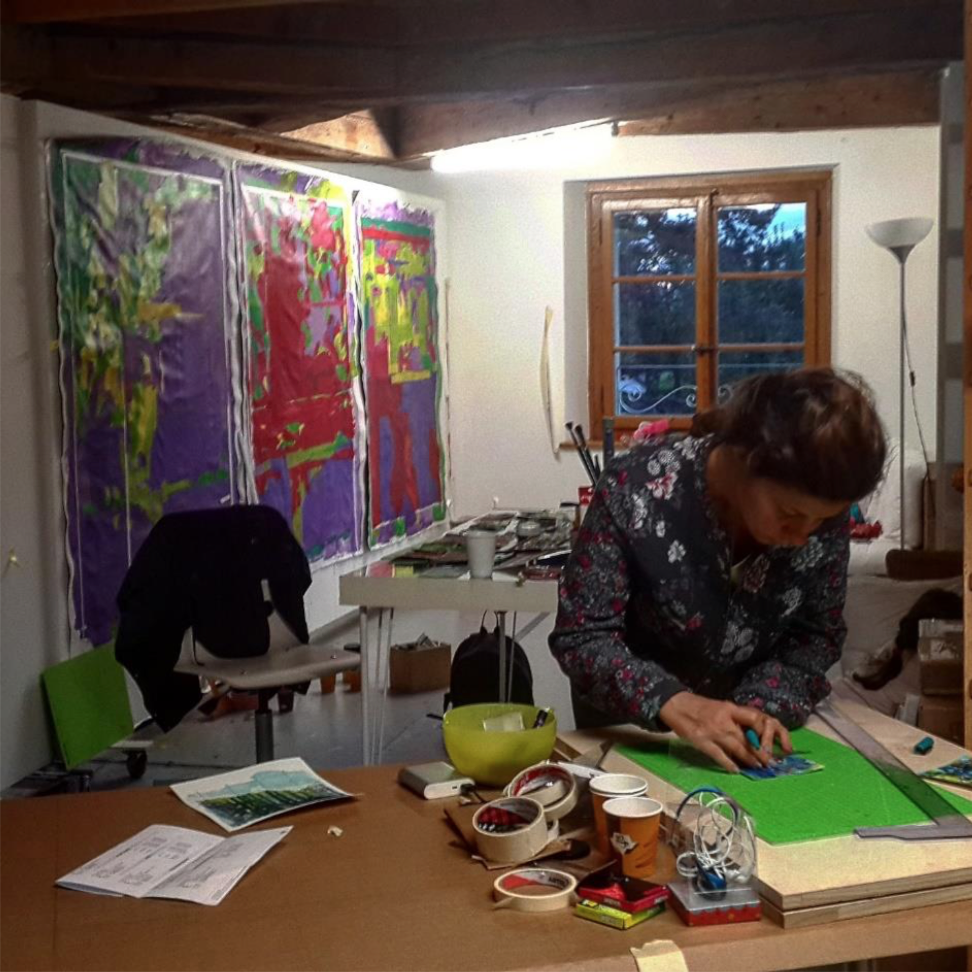


I was in the empty big walls and studio. I prepared many different projects samples on the installation.  I collected many things, such as maps, and used them in the installation. For example, I found plants  and leaves on the street - I liked them, picked them up and used them in the installation. They are still living in the my Istanbul studio.


Nina organized an open studio and an exhibition before the residency finished. 

After that we went for a trip other cities in Switzerland (Lausanne, Neuchatel, Bern, Zurich, Basel) in a  week.  

When we came back Istanbul from Trelex Art Residency, I felt calm and ready for new projects. It was  very good experience for my art discipline.

www.secilerel.com


A typical Trelex project


I just wanted to add a quick note about a recent event at Trelex that was really very very special to me. Early last week, I a book arrived from Holland and landed on my kitchen table. This would in and of itself have been celebrated with a long cup of coffee and some hours of reading in a hammock but this was a very very special book. It had been conceived by Michiel Shepers at the other Trelex Residency, deep in the Peruvian Amazon, around notes, sketches and watercolours made there while on a month long residency and then been finished with a lot of consideration in Leiden over the following 7-8 months.

As if that wasn't enough, when I contacted Michiel Schepers to thank him and to suggest that he come to Trelex and work on turning the book into an artist book edition, he announced he would swing by for a night a few days later as he was on his way to a trip round the alps.

So I had an opportunity to put to good use all I had learnt last summer on the Trelex Book Art Summer retreat as I passed on knowledge I have been given by other residents to Michiel and taught him so basic Adobe Indesign. We worked hard for a good 24 hours together (Michiel far longer hours than me!), discussed every detail of the text, font, layout, line spacing, captions, dedication, cover design, image/text arrangement, title, exchanged a ton of ideas (some completely tangential to the actual book) and got the book into pdf format to be enjoyed online for now:


Secil Erel and Gizem Ünlü - presently residents at Trelex - joined in the discussion and helped resolve points Michiel and I were in disagreement over. It was a real treat to be at the centre of so much given and received and feeling the international network of artists continue to grow around the residencies.

The next step will be to find a printer who can turn this book and some of the book projects that have taken shape here in Trelex into printed volumes in small runs (100-200 volumes) without compromising on quality or breaking the bank. Does anyone know such a printer in Switzerland or in the UK?

Hopefully this will inspire other to take a chance on an Artist without any application forms (the creative equivalent of putting the cart in front of the horses). More often than not this produces something of value that surprises both the host and the artist in equal measure - something that couldn't have been planned for without considerable anxiety on both sides of the equation.


Brainstorming for the Arts, Gender Parity and Education

Recently, Caroline Watson, the brains behind the notion of a Global Arts Agenda came for a return visit to the Trelex Residency - this time with her husband and two wonderful accomplices: Fanny Ollivier and Richard Sobey. They turned the studio into a boardroom and think tank. Ideas, plans, strategies and debate whirled around for three intense days.
Fanny, Caroline and Richard plotting away.
The concept is to establish an international body (perhaps under the aegis of the United Nations) to 'enable business and government to use the arts in human development'; to be a forum for discussions on best practice; to lend international support to fledging efforts in countries where the arts are undervalued... etc. Unesco does a lot through its World Heritage programme but the emphasis is on historical patrimony rather than living breathing happening sort of Art that provides the real fibre of a living culture. And as artist we all know that when it comes to Art, most politicians don't know what they are doing and could benefit a lot from a code of best practice as to how to connect policy with people, artists, creative innovation and solutions based on a thriving arts culture.
The view from the corner of the studio where I was working

I was of course listening in intently and trying to speak a bit for the visual artist whose work may be neither hobby, business, therapy, educational or social project or particularly altruistic in any way but which tends often to be sidelined in funding, residencies and support for the arts which is becoming increasingly focussed on end products. Yet defining the output ahead of the creative process is like putting cart in front of the horses: it chokes creativity rather than giving it free rein.
Unusual creative process using post-its and numbers.
My husband, the philosopher David Rodin asked some pertinent questions on how the Council would define itself and its objectives so as not to become prescriptive, restrictive or biased towards western cultural values.

And Professor Jem Bendell shared a lot of insights on the inner workings of the United Nation agencies: how best to collaborate and innovate with the existing platforms. Would there be scope for an inter-agency meeting of elements working on aspects of the Arts already? Before we new it, we were planning for 80,000 sqm of industrial land belonging to the city of Geneva and diverging somewhat on making the arts scene there explode into something worth moving for.

So hopefully there will be more meetings ahead. I hope to meet the Maire of Geneva again with Jem, to learn about Swiss funding for the Arts with Fanny Ollivier and brainstorm the growth of the Trelex Model with the Amazing Richard Sobey in the near future.
Richard's enticing business card on my desk with my painting.
This inspiring weekend followed on directly from the Young Global Leaders summit at the headquarters of the World Economic Forum in Geneva where I once again used my privileges as a spouse to raise my voice on the importance of Arts for Art's sake, Gender parity and Education - three issues that never fail to fire me up.
Sustainable development goals notice board at the WEF
with Quality Education no.4 and Gender Parity no.5..


and no.18 added by yours truly. One day they will politely ask me to leave...
1. On the Arts front: I gatecrashed a small meeting of Young Global Leaders working in or with the Arts talking about how the Arts can have a more serious place in the World Economic Forum. It was heart warming and encouraging to see so many engaged young leaders (who have to be both leaders in the field and seriously engaged in improving the state of the world to be elected) concerned with the place given to the Arts and to hear of the steady progress made so far. Art has slowly been moved away from being something to decorate the wall between he coffee machine and the water dispenser and a source of relaxation or entertainment for forum attendees between sessions dealing with the intellectual hard core of the Forum to some tentative attempts at centre stage. Still, as the people in the room introduced themselves, the focus seemed to be firmly on art markets, art as entertainment, art as therapy (including a neuroscientist who had studied the relaxing properties of viewing art), art as vehicle for political change (documentary and fiction in the Israel/Palestine conflict), art as education tool... etc.... - in short, Art as a tool with applicable use. I bit my tongue for as long as I could but in the end, when it came to introducing myself, I said something along the lines of:
'I am Nina Rodin. I am an Artist. My Art is not a hobby, is not a business (God know I am not making a penny of it and it's costing me a fortune!), is not entertainment, is not good as decoration, will not solve political problems, does not aim to influence or teach. Some of my work stresses people and I make no apologies for that. But my art is not the soft option. I have been an astrophysicist and a neurophysiologist and written theses and published papers in both  - but I swear being an Artist is the hardest, most intellectually challenging thing I have ever done. Art is not the soft option to be indulged in my spare time. It is lonely, hard, underfunded, misunderstood. But can we please start to take it seriously?!!'
I didn't get thrown out of the room but got handshakes from a lot of people for the rest of the conference. So perhaps there is hope after all...

2. On the Gender Parity front: Years of campaigning softly (and sometimes less softly) on the sidelines about having a children's programme at such summits came to fruition. With the help of Jennifer Corriero, Lisa Neuberger and Rosy Mondardini, we put a children's programme together to run through the YGL summit - very generously and somewhat extravagantly supported by the WEF. Throughout the week, people approached me to thank us and explain what an extraordinary impact it had had on their experience and their ability to work to have their children both nearby and independently looked after. I hope this will now become a mainstay of WEF conferences and the organisation can become a leader here as well in setting a new standard for work-life integration that benefits both parent-professionals and their children. Think of the difference it would make to have similar facilities at large annual Neuroscience Conferences and at large Art fairs. And it is an extremely potent way of closing the gender gap: it makes it possible to combine professional excellence with parenting excellence. If, as in this case, the conference participants themselves contribute to the children's programme, then educational excellence for the children is seen to be complementary and not in conflict with professional excellence. I lost count of how many conference attendees told me with a palpable sense of relief that next year perhaps they would also bring their children.
My Art Theory Workshop in full swing...

Three children with an artwork of their choice explaining why
they have chosen it and what the artwork says about their individuality.
3. On the Education front: I had more interaction and discussion with the extraordinary Claire Boonstra of Operation Education, a dutch initiative looking to completely rethink children's education in the light of modern scientific evidence and studies of best practice around the world. I am particularly moved by Claire's intuitive understanding of the place of creativity in such new educational paradigm. Am hoping to become a Swiss ambassador for her organisation. But more about that soon hopefully. I leave you with links to her two ted talks: talk 1 and talk 2. Makes me cry every time. Who is with us?
Claire Boonstra: how difference from the norm is seen as failure.
Now how do you explain that as a problem to the Swiss?
Nina Rodin - August 2015, Trelex.

From Rona Shahar

01.07.2015 - 31.07.2015


Trelex Times.  It all started in late 2014. My friend Ora Ruven recommended I contact artist Nina Rodin for a free residency she's been offering in Trelex, Switzerland, saying "I know you like these things". And surely I do (Free residency! Switzerland!), so I wrote immediately and got to stay 6 weeks in the summer.


If you looked  at the website and read some you may think - oh, how nice. Well you have no idea how. It's my third week here,  and I am still finding out more about the possibilities of using my time here - everything, just everything, overflows or grows on trees. You just tune in and bathe yourself in calm delicious waters, ideas, beauty, serenity and inspiration.


I wasn't sure how much I would like Switzerland. Italy was still on my mind from my previous trip. Its northern neighbor looked much less colorful,  the architecture of old villages here mimics the mountain ranges with their pointed slopey tops. Often cloudy and rainy, much fewer people in the  streets, pricey of course. That was my first impression. But then I arrived into the micro-country of Trelex and things changed. In short, we (there usually are two artists or more at the same time) can use the residency in any way we like, there are no restrictions. There's ample materials to use in the studio itself and a zillion appetizers in the nature outside, even looking through the windows. What really started me up, strangely enough, was an innocent set of color markers left by one or more of the previous artists. The other thing was the heat wave - a long week of ever increasing temperatures, which forced me to wander away from the house into the woods, where I would sit under the heavy shade and look around me. The following works all from the same window show my progress with markers.


From Marina Carvalho

Here is a really wonderful and original trip around Marina's experiences in Trelex. Photos will follow soon, especially of the first permanent sculpture in the garden....


Just click on the image above, open in full screen and use the arrows at the bottom to navigate the mind map. You don't need to install any software. Easy-peasy.

See some of Marina Carvalho's work here.

From Ranadip Mukherjee

01.06.2015 - 30.06.2015


I was working one full month in June 2015 in Trelex. Probably I was the first Indian artist,who worked there. It was a nice experience. Very calm and silent. Nina, the founder of this residency, is always very generous to the artist and extremely helpful lady. I shared my studio in Trelex 1st couple weeks with a Video Artist Ilana Simons from USA and next few weeks of my stay with an artist from Israel Rona Shahar


I travelled all the way from Mumbai the business capital that is where I paint and have my studio and it is said that 'Mumbai never sleeps' from there when I reached Trelex in the small village of Switzerland first that touched me was an amazing silence that was exactly the silence I wanted to feel and capture through my colours. This journey of mine to Trelex will always stay in my heart. Maybe, I'll come back once again. Thanks to Nina Rodin.


From Ilana Simons

01.06.2015 - 19.06.2015


What makes the Trelex Residency so unique is a certain special system of lawlessness and anonymity –a residency model that’s based on trust. There are no applications, no fees.

Nina calls it the Trelex Model, and is in the process of exporting this dreamscape to other locations like Peru and Pakistan.

Four years ago, Nina turned the top floor of her own home into an artists’ retreat with the desire to have likeminded makers in her space.  After art school in London, she moved with husband David (a moral philosopher) and their three kids to the Swiss town of Trelex, with the small population of about 1,400. Nina found herself in a bright studio with views of the Alps, but watching the cows and missing the productive chaos of human voices. She restructured her home off a unique ethical gamble: you might invite artists/strangers into your house and trust them, off the bold fact that they’ve traveled a long distance to show up and make things with you.


There are already many residencies available, Nina says, for artists who go to art school and build CV’s angled for a life in the art market. But there are almost no opportunities for artists without that CV— imaginative minds who work almost secretly but might find themselves especially triggered, wired, and driven by this stretch of free time in a grand space in which they are asked nothing about who they are or what they promise to produce. If someone knows herself to be invested in making art, reads through the Trelex website without much guidance from outside sources, requests an occupancy, and buys a ticket to Geneva six months in advance (which is about how quickly spots fill up), then that person is invested. And, when we arrive, we see the full gift: the huge house lined with vines, the strawberries for picking in the garden, the bikes and cars available for use, the mountainsides striped with hiking trails. The surprise of the gift is enough to set an unusual mutual generosity into motion. People generally worry about what others think of them, Nina says. If you enter someone’s house, and it’s beautiful, and she asks nothing about who you are, you have some impulse to return the spirit. Just so, her house holds the trail of past creative minds that seem to have lived there, open—pastels left behind, charcoal pencils, Japanese paper, twelve bottles of glue, chocolate in the cabinets, a bottle of wine. Nina herself offers an almost endless supply of other things for making art. Then that’s what happens: you show up and you make art.


I shared my three weeks of residency with an Indian painter named Ranadip Mukherjee. Nina met us both at the airport/train station and invited us to scour the airport supermarket for a while before driving us back to the house.

The two artists in residence at any one time sleep in the loft upstairs, which also houses the studio, made of about 700 square feet with moving walls and windows for natural light. Nina and her family live on the first two floors. There is a rather neat division: you get to know the dog, the brilliance of her kids (one has unbounded knowledge and passion for Greek myth), and some rooms in the house itself are great reading hideaways, like this veranda on the second floor where I had wine and wrote romantically.


Ranadip usually woke up earlier than I did and would quietly start his watercolors by the rising sun at the open window. I am a video artist so the trajectory of my day was more scattered: filming Nina’s daughter (an excellent actor; she has insights into American culture), or painting trees in the garden for set pieces, or doing set pieces of Freud and a collage of Nina.


I took many day trips: Geneva is a good one, for its museum of contemporary art (MAMCO), where I enjoyed the short films of one queer sexualized wonderkind whose name I’m not remembering. Another great outing is to Lausanne, for the Collection de L’Art Brut, all art done by true outsiders, most of them in mental institutions. Both places are accessible from right outside Nina’s house, via train.

I took daily bike rides into Nyon, where the food shopping is best.  I did a daily runs to Crassier, a neighboring town, for which I passed through the most beautiful white/green striped landscapes with lake far below.

I came back home to New York with little nuggets on psychology from Nina. Questions asked: How does she handle the diversity in her house--the minds that come through which annoy her with their politics, or their rudeness, or their myopia, or whatever might bug her?  Smiling wider than the rim of her coffee, Nina said, “But I love and hate everyone. There is no other way of knowing someone.” It takes balance to welcome the differences in and engage with it. Her life has taken on the task of that engagement. Then: how does she trust that she’s not opening her house to freeloaders? “I ask that anyone who comes read the website and, without much dialogue, buy a ticket across the world.  That shows someone’s commitment, doesn’t it?”

True.

---

Me: I’m Ilana Simons, an artist and psychologist who lives in NYC and was delighted to share Nina’s space for three weeks while I worked on my video about heartbreak.  See some of my videos here: https://vimeo.com/ilanasimons